
The History and Origins of Thai Massage
Explore the ancient history of Thai massage and how Alanna Wellness & Spa in Phuket preserves authentic Thai healing traditions in every treatment.
| In This Article
1. Origins in Ayurveda and Buddhism 2. The Father Doctor Shivago 3. Sen Lines Explained 4. How Thai Massage Evolved 5. Traditional vs Modern Thai Massage 6. At Alanna Wellness 7. FAQ |
A Healing Art More Than 2,500 Years Old
Thai massage is one of the oldest therapeutic traditions in the world — a healing system that predates modern medicine by millennia. At Alanna Wellness & Spa in Laguna Bangtao, Phuket, the authentic foundations of Thai massage inform every treatment our therapists deliver. Understanding its origins deepens the meaning of each session and reveals why this ancient practice remains one of the most effective bodywork modalities available today.
The Origins: Ayurveda, Buddhism, and the Body as Energy
Thai massage traces its roots to ancient India, where the Ayurvedic system of medicine had mapped the human body as a network of energy channels — known as nadis in Sanskrit — through which vital life force (prana) flows. When these channels become blocked through stress, injury, or illness, the flow of energy is disrupted and physical or emotional symptoms emerge.
This Indian framework travelled to Thailand along the Buddhist trade routes between India and Southeast Asia, approximately 2,500 years ago. As Buddhism became embedded in Thai culture, its compassionate philosophy of healing became inseparable from the practice of medicine. Thai medicine was understood not as a clinical transaction but as an act of metta — loving-kindness — between healer and receiver.
The Father Doctor: Shivago Komarpaj
Thai massage tradition attributes its founding to Jivaka Kumar Bhaccha — known in Thailand as Shivago Komarpaj — a physician who is said to have been the personal doctor of the Buddha and a master of Ayurvedic medicine. Statues and inscriptions of Shivago are found at Wat Pho in Bangkok, the ancient temple that has served as the formal repository of Thai massage knowledge for centuries.
Today, practitioners of traditional Thai massage often recite a meditation to Shivago before beginning treatment — a practice that preserves the spiritual and compassionate intent at the heart of the tradition.
Sen Lines: The Energy Channels of Thai Massage
The theoretical foundation of Thai massage rests on the concept of Sen lines — a system of 72,000 energy pathways mapped throughout the body, of which ten primary channels (Sen Sib) are considered most therapeutically significant. These Sen lines do not directly correspond to anatomical structures like nerves or blood vessels, though many run parallel to them.
Thai massage therapists apply pressure along Sen lines using thumbs, palms, elbows, knees, and feet — in combination with assisted yoga-like stretches that open joints, lengthen muscles, and release tension stored along the Sen pathways. The result is a treatment that addresses the whole body as an interconnected system rather than isolating individual muscles.
How Thai Massage Evolved Through the Centuries
Thai massage was preserved and transmitted through Buddhist monasteries, where monks served as healers to their communities. Wat Pho in Bangkok became the first formal school of Thai massage in the nineteenth century, under the reign of King Rama III, who commissioned the recording of Thai medical knowledge in stone inscriptions that remain on the temple walls today.
The twentieth century brought Thai massage to international attention as tourism opened Thailand to the world. What had been a localised healing tradition became a globally practised modality — and one of Thailand’s most significant cultural exports.
Traditional Thai Massage vs Modern Adapted Versions
Traditional Thai massage (nuad boran — ‘ancient massage’) is performed on a floor mat, with the receiver fully clothed in loose garments. There is no oil. The therapist uses their entire body — including their feet — to apply rhythmic pressure and facilitate deep stretching. A full traditional session lasts 90 minutes to two hours and addresses the entire body systematically.
Modern adaptations — including oil-based Thai massage, table-based versions, and targeted treatments focusing on specific body areas — have evolved to meet the preferences of international guests. At Alanna Wellness & Spa, both authentic traditional and adapted approaches are available, with therapists trained to recommend the most appropriate technique for each guest’s condition and preference.
Thai Massage at Alanna Wellness & Spa
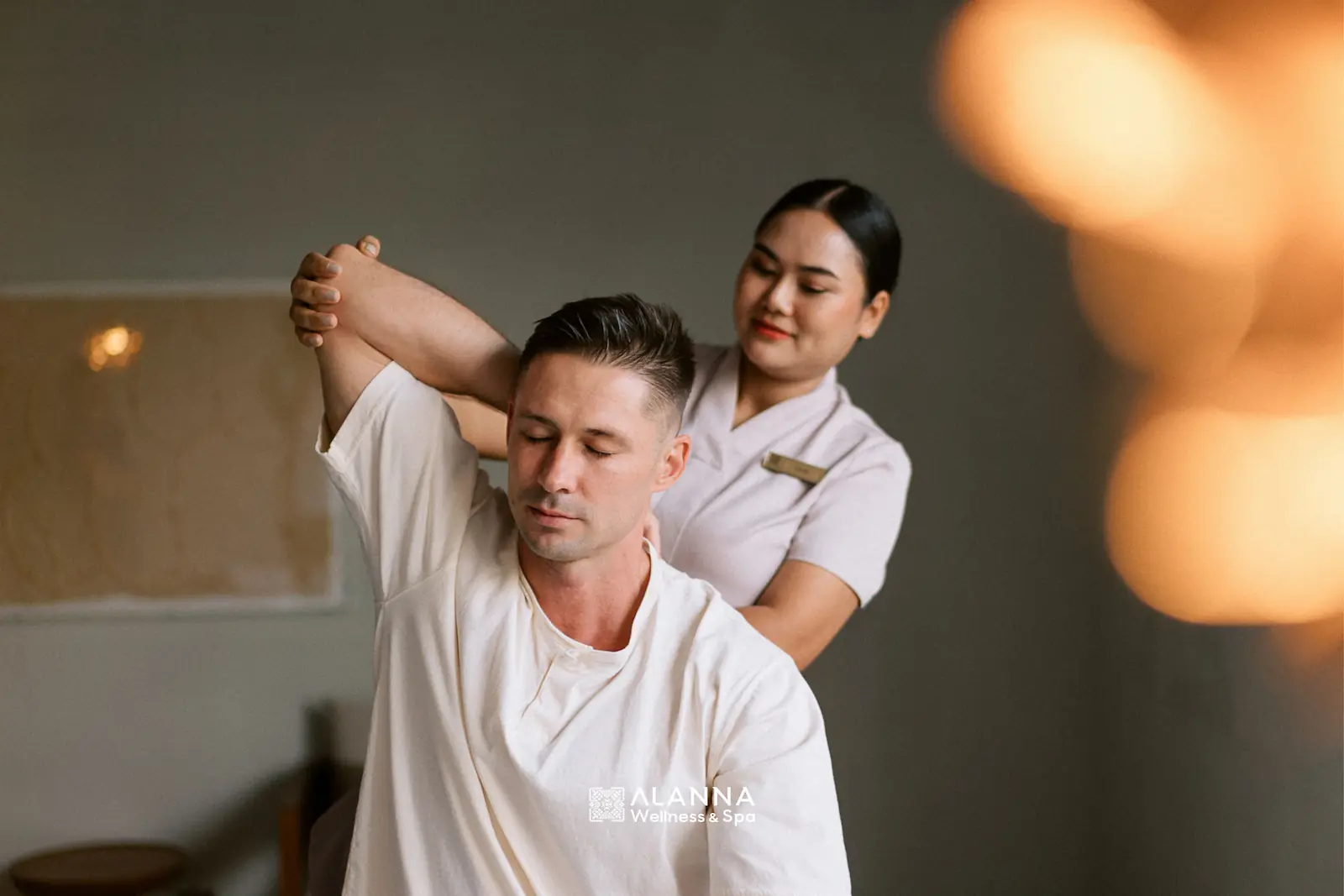
Alanna’s relaxation massage programme includes traditional Thai massage delivered by therapists who have trained extensively in both the theoretical and practical dimensions of Thai healing. Beyond technique, Alanna therapists understand the meditative quality that distinguished traditional Thai massage from simple bodywork — the intention to genuinely support the wellbeing of the person on the table.
For guests seeking to deepen their understanding further, Alanna’s Art of Thai Touch workshop offers couples the opportunity to learn foundational techniques from a certified Master Therapist in a 90-minute guided session.
Frequently Asked Questions
Is Thai massage painful?
Traditional Thai massage can involve firm pressure and deep stretching, which some guests experience as intense. Good therapists calibrate pressure to each individual’s tolerance and respond immediately to feedback. If you prefer lighter pressure, always communicate this before and during the session.
What is the difference between Thai massage and Swedish massage?
Swedish massage uses oil and focuses on muscle relaxation through long, flowing strokes. Thai massage uses no oil, involves passive stretching and joint mobilisation, and addresses the body’s energy system alongside its physical structure. Thai massage is generally more active for the receiver; Swedish massage is more passive.
How long should a Thai massage session be?
Sixty minutes provides a meaningful session focusing on key areas. Ninety minutes allows for a comprehensive full-body treatment. For your first experience, 90 minutes is recommended to allow the body time to fully open and respond to the therapeutic sequence.